21 Lutetia
Filed 14 July 2010
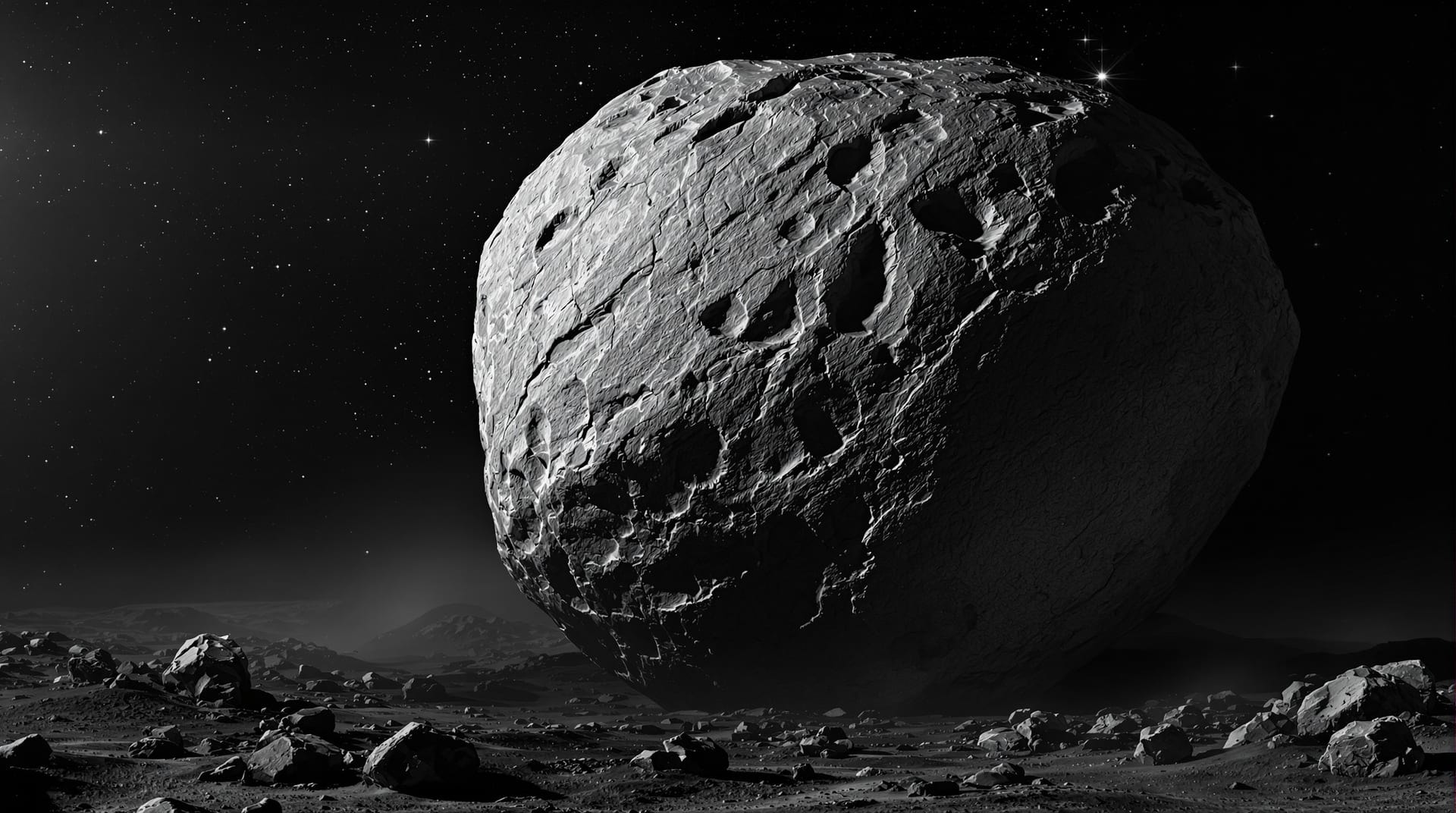
The asteroid 21 Lutetia orbits between Mars and Jupiter, and this month a European spacecraft passed within about two thousand miles of it, returning the first close images humanity has of the object. The probe was not built for this. It was built to chase a comet, and Lutetia was a target of opportunity along the way.
An old rock with an unresolved identity
Lutetia was discovered in the middle of the nineteenth century and named for the Roman settlement beneath modern Paris. At roughly a hundred kilometres across it is one of the larger members of the main belt, and it has been a puzzle for decades because its measured properties refuse to sit neatly in any single classification.
Some observations suggest a primitive, carbon-bearing body little changed since the solar system formed. Others point to a metal-rich composition closer to the exposed core of a larger object that was broken apart. A flyby resolves questions that no amount of telescope time can: shape, cratering, density, surface texture — the physical evidence that distinguishes a fragment from a survivor.
Why the main belt matters
The asteroid belt is often described as the debris of a planet that failed to form, which is roughly right and useful. Jupiter's gravity stirred the material in that zone hard enough that it never accreted into a single body. What remains is a population of objects that preserve the chemistry of the early solar system without the heating and reprocessing that erased that record on the planets.
Reading them is the closest thing available to reading the composition of the disk from which everything else was made. That is why so much spacecraft time is spent on rocks that look, in a photograph, like grey potatoes.
The economics of a flyby
Interplanetary missions cruise for years between arrival events, and a well-planned trajectory can be nudged to pass near targets of opportunity for a modest fuel cost. The instruments are already aboard; the operations team is already funded. The result is that a mission designed for one destination can deliver an entire secondary science return on the way — a habit that has produced a substantial fraction of what is known about small bodies.
What the encounter can measure
A flyby is a brief event — the useful window is measured in minutes — and everything worth having is collected inside it. The imaging system maps shape and cratering, which together give an age estimate: a heavily cratered surface has been exposed for a long time, a smooth one has been resurfaced or is young.
Spectrometers read the light reflected from the surface across wavelengths the eye cannot see, and different minerals absorb at different wavelengths, so the spectrum is a compositional fingerprint. And the spacecraft itself becomes an instrument: the asteroid's gravity deflects its path by a measurable amount, and that deflection gives the object's mass. Mass divided by the volume derived from the imaging gives density — the single number that most sharply separates a solid fragment from a loosely bound rubble pile.
Naming and the catalogue
The number in the designation is a discovery sequence, not a size ranking: 21 Lutetia was the twenty-first asteroid ever catalogued, found in the middle of the nineteenth century by an observer working from a city observatory with equipment that would now be considered modest. The name is the Roman settlement beneath modern Paris.
That catalogue is still maintained, and it has grown from a few dozen objects to hundreds of thousands. Every one carries a provisional designation on discovery, a permanent number once its orbit is secure enough to guarantee it can be found again, and a name only after that.
What to watch next
The processed imaging and spectra, which will settle the composition question one way or the other; the refined mass and density figures derived from the spacecraft's deflection during the pass; and the probe's primary objective still ahead of it at the comet. Mission updates are published by the European Space Agency, and orbital elements and designations for every catalogued small body are maintained by the IAU Minor Planet Center.